
Smart City and Artificial Intelligence
Bitkom has published the Smart City Index and ranked one of our Hamburg locations in first place, just ahead of Munich. In Bielefeld, our main location, we are still lagging behind and were only able to take 46th place.
But what does the Smart City Index mean, what is Smart City anyway and how does artificial intelligence come into play in the whole story?
What is meant by smart city?
A smart city has a high degree of intelligent and networked digitalization. It plans your resources based on data & software. Your citizens are able to use your public services digitally, conveniently and efficiently. It also offers its citizens various digital services and thereby increases the quality of life.
In general, one can say: A smart city understands how to offer its citizens a better life through digitalization and the associated options (apps, websites, hardware, public WiFi, artificial intelligence).
What does the Smart City Index mean?
The Bitcom Index ranks all cities with over 100,000 inhabitants based on publicly available data and data provided by cities. He divided the categories into society, mobility, IT & communication, energy and environment and administration.
The final index represents an average of the ratings in all individual categories.
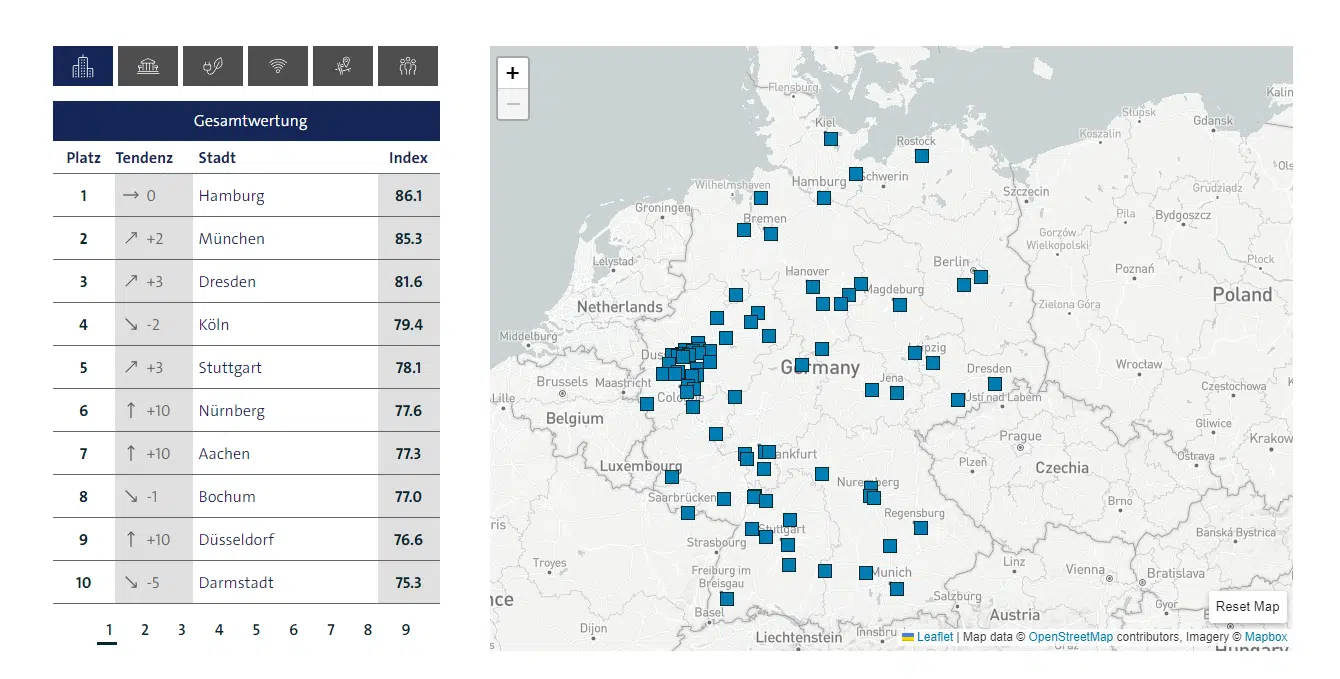
Artificial intelligence and data science in smart cities?
Smart and modern administrations have recognized that the core of every smart city is data-driven applications. Here are some examples from practice:
Intelligent lighting control
By tracking energy consumption, solar generation, crime data, traffic and more, artificial intelligence can maximize residents' availability, energy consumption and sense of security.
Intelligent traffic light control & speed limit
The self-collected traffic data provided by third parties makes it possible to feed intelligent systems with enough input to make the traffic light switching extremely dynamic. This results in shorter travel times, lower CO² emissions and more efficient infrastructure. In combination with intelligent instead of static speed limits, traffic light control can become even more efficient, the safety of road users can be guaranteed and CO² emissions can be minimized.
AI driven chat bots and automated public services
Good chatbots and software workflows make it possible to fully automate manual services with long waiting times and to use the human resources thus freed up in more useful places. There are currently > 100,000 public positions unfilled and waiting times in large cities for public services are often in the range of several months.
Fighting Crime
Intelligently controlled police presence is easily possible through the use of data science and artificial intelligence. There are some successful examples of this. Burglary rates, general crime levels and the population's sense of security can be greatly optimized through a data-driven approach rather than gut feeling.
Forecasting for construction site planning
When it is best to open a construction site and what impact this has on traffic is a science in itself. Through a data-driven and AI-driven approach, it is possible to minimize the inconveniences created by construction sites by setting them up at the optimal time and setting a schedule that minimizes the impact.
Smart and digital waste management
Data-driven control of cleaning, garbage collection and public order office resources can enormously improve the cityscape and thus the well-being of its citizens. Using limited resources at the right time and to the right extent maximizes the cleanliness of the cityscape and minimizes the associated effort.