

Use cases that really pay off.
We prioritize use cases by minimal effort and maximum business value – and get them into production in 1–3 months.
- 100+
- use cases in our portfolio
- 1–3
- months to go live
- 500+
- data & AI projects
- 10
- industries
Example use cases at a glance
Every use case has its own detail page – with ROI, approach, required data, stakeholders and synergies.
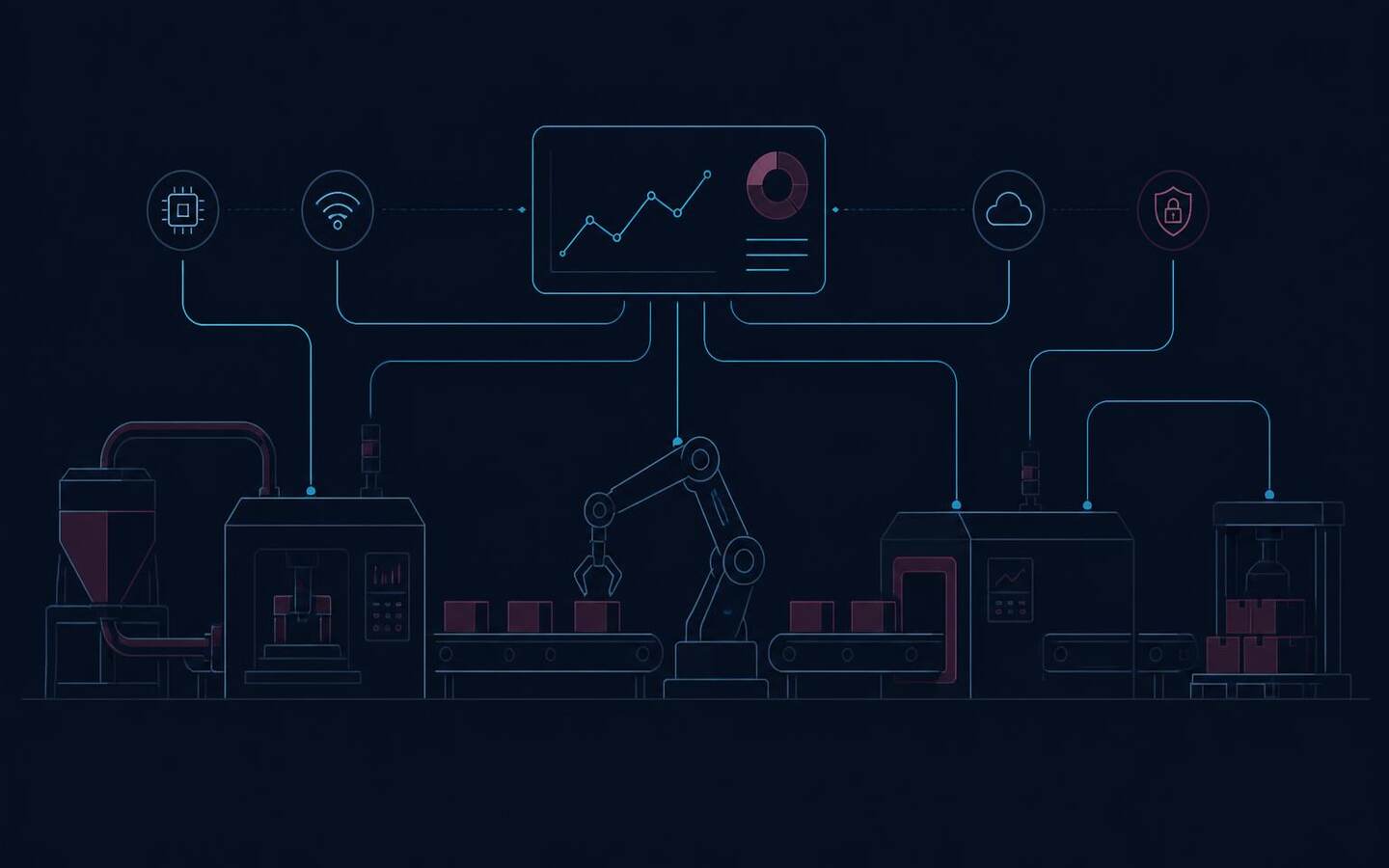
Industrial AI
10 Use cases
AI directly on the machine, line and supply chain – from predictive maintenance to energy optimization.
Predictive Maintenance
Predict machine failures and optimise maintenance.
Predictive Quality
Spot scrap before it happens.
Anomaly detection in time series
Spot unusual patterns in machine data instantly.
Visual quality inspection
Automatically detect defective parts using cameras.
Process parameter optimization
Control reactors and plants at their optimum.
Energy & consumption optimization
Cut energy costs without slowing production.
Production planning & scheduling
Automatically distribute orders optimally across machines.
Demand & sales forecasting
Forecast demand more precisely than experience alone allows.
Inventory & spare parts optimization
Keep exactly the right parts in stock — no more, no less.
Digital twin & simulation
Test production changes virtually, risk-free.

Generative AI
10 Use cases
LLM assistants based on your own data – GDPR and EU AI Act compliant operated in EU regions.
Internal company GPT
A company-owned chat assistant that reliably answers questions on processes, policies and expertise.
Document chat (RAG)
Search large document sets via chat instead of manually digging through contracts and reports.
Service & repair assistant
Technicians get precise repair guidance on-site, drawn from manuals and ticket history.
Quote & tender assistant
Draft quotes and tender documents faster, backed by past deals and price lists.
Email & ticket triage
Automatically classify, prioritize and route incoming emails and tickets to the right team.
Knowledge management & onboarding
Onboard new employees faster with an assistant that explains company-specific knowledge.
Content & product data creation
Generate product descriptions and marketing copy automatically from structured product data.
Meeting & minutes assistant
Automatically summarize meetings, extract action items and file minutes in a structured way.
Code & migration assistants
Support developer teams with code reviews, documentation and legacy system migration.
Agentic workflows
Automate multi-step business processes with AI agents that connect systems autonomously.

Data platform
10 Use cases
The foundation: securely integrate, model, govern and operate data productively.
Lakehouse architecture
A central lakehouse replaces the patchwork of data warehouse, data lake and Excel exports.
Data integration from ERP & MES
Automatically merge ERP and MES data instead of exporting and reconciling manually.
Streaming & real-time data
Instead of daily batch runs, relevant metrics are available within seconds.
Data modeling & semantic layer
A shared semantic layer ensures 'revenue' means the same thing everywhere.
Data quality & observability
Catch data errors before they land in the management report.
Data governance & permissions
Who may see and change what? Governance makes this traceable instead of arbitrary.
Cloud migration & modernization
Retire aging on-premise systems without putting live operations at risk.
MLOps & model operations
Don't just train models — operate them reliably and traceably.
Cost optimization (FinOps)
Make cloud costs transparent before the next bill causes surprises.
Data products & self-service
Business teams serve themselves with data instead of waiting in the IT queue.

Business Intelligence
10 Use cases
From reliable key figures to a management cockpit that is actually used.
Management cockpits
Revenue, margin and cash at a glance – updated daily instead of once a month.
Finance & controlling reporting
Month-end close and cost-center reports without an Excel marathon at the start of the month.
Sales & CRM analytics
Make pipeline, forecast and customer potential visible instead of guessing in the CRM.
Production & OEE reporting
Availability, quality and performance as a metric instead of gut feeling.
Supply chain reporting
Delivery reliability, inventory and freight cost visible along the entire chain.
Self-service BI enablement
Departments build their own analyses in Power BI instead of waiting on IT tickets.
KPI framework & definitions
One binding definition per metric, instead of five versions of 'revenue'.
Planning & forecast reporting
Plan-vs-actual comparisons automated, instead of painstakingly maintained Excel planning tools.
Embedded analytics
Analytics embedded directly in business applications instead of a separate BI tool.
Reporting automation
Recurring reports run automatically instead of being rebuilt every month.
ROI calculator for your use case
Choose a use case, enter your own figures and see in seconds whether it pays off. The defaults are realistic benchmarks from our projects.
Maschinenausfälle vorhersagen, bevor sie teuer werden.
How the value is created
Ungeplante Stillstandsstunden pro Jahr × Kosten je Stillstandsstunde ergibt das jährliche Kostenvolumen des Problems. Davon wird der Anteil angesetzt, den der Use-Case realistisch adressiert (Reduktion ungeplanter Ausfälle).
The result is the annual gross benefit. We deduct recurring costs and compare the balance with the one-off project costs to calculate ROI, payback period and the three-year effect.
Lighthouse project cost range: €25,000–50,000 project cost, €8,000–12,000 run cost per year.
Result
Predictive Maintenance
Avoided downtime and maintenance costs p. a.
€31,920
less recurring costs: €22,920 net benefit p.a.
- ROI in year one
- +72 %
- Payback period
- 16.8 months
- Net effect over 3 years
- €36,760
Costs vs. benefits over 3 years
Simplified model based on your assumptions — not a quotation. During the potential assessment, we calculate the case using your real data.
An initial indication — not a full business-case calculation
The calculator deliberately uses only a few variables. A robust business case depends on many more factors: data availability and quality, existing systems and interfaces, process maturity, rollout scope, change and training effort, operating model, regulatory requirements, and actual cost and contribution-margin structures. We review these factors together and then calculate the case using your real figures.