
Increasing Prediction Accuracy: How Conformal Predictions with Random Forest and MAPIE outperform RMSE
Conformal Predictions: An Overview of Concepts and Implementation
Accurate prediction of values plays a central role in the area of Industrial AI and forecasting, for example. Whether it is about optimizing production processes or predicting sales figures, the reliability of the predictions is crucial. This article highlights the concepts of conformal predictions, their use together with random forests, and the advantages over traditional methods such as RMSE (Root Mean Squared Error).
Introduction to Conformal Predictions
Conformal predictions are a statistical tool that allows prediction intervals to be calculated for individual predictions. These intervals indicate the probability that a predicted value lies within certain limits. A main advantage is that they work independently of the error distribution and are universally applicable to different models.
Advantages:
- Local uncertainty assessments
- Adaptable to a wide range of use cases
- Can be integrated into existing model infrastructures
2. Application of conformal predictions with random forests
Random Forest, an ensemble learning algorithm, is known for its robustness and predictive ability. By integrating conformal predictions, random forests can be extended to provide prediction intervals that go beyond pure point prediction.
Implementation Steps:
- Model Training: Train the random forest on the existing data.
- Conformal Estimation: Calculate the prediction intervals through conformal evaluation strategies.
- Evaluation: Compare the obtained intervals with the actual values to confirm the confidence level.
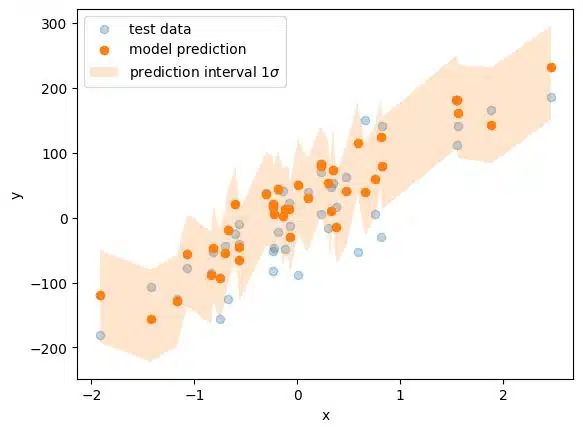
3. Implementation with MAPIE
The Python package MAPIE (Model-Agnostic Prediction Interval Estimator) provides an easy way to implement conformal predictions for various machine learning models, including random forests.
Advantages of MAPIE:
- Easy to integrate
- Model independent
- Customizable for different confidence levels
Example integration:
from mapie.regression import MapieRegressor
from sklearn.ensemble import RandomForestRegressor

# Data and model initialization
model = RandomForestRegressor()
mapie = MapieRegressor(estimator=model)

# Training the model with adaptation
mapie.fit(X_train, y_train)
preds, intervals = mapie.predict(X_test, alpha=0.32) # Example of 68% confidence level
4. Evaluation and comparison with RMSE
The RMSE is an indicator of the average deviation of the model predictions from the actual values. While RMSE provides us with a global model evaluation, conformal predictions provide detailed information about the uncertainty of each individual prediction.
Comparison:
- RMSE: Measurement of average model accuracy.
- Conformal Predictions: Provision of specific prediction intervals with defined confidence levels.
5. Conclusion
Conformal predictions represent a significant expansion for applications where not only prediction accuracy but also prediction confidence is important. By integrating with technologies such as random forests and tools such as MAPIE, companies can substantially improve the reliability of their model results and make data-driven decisions more efficient.